

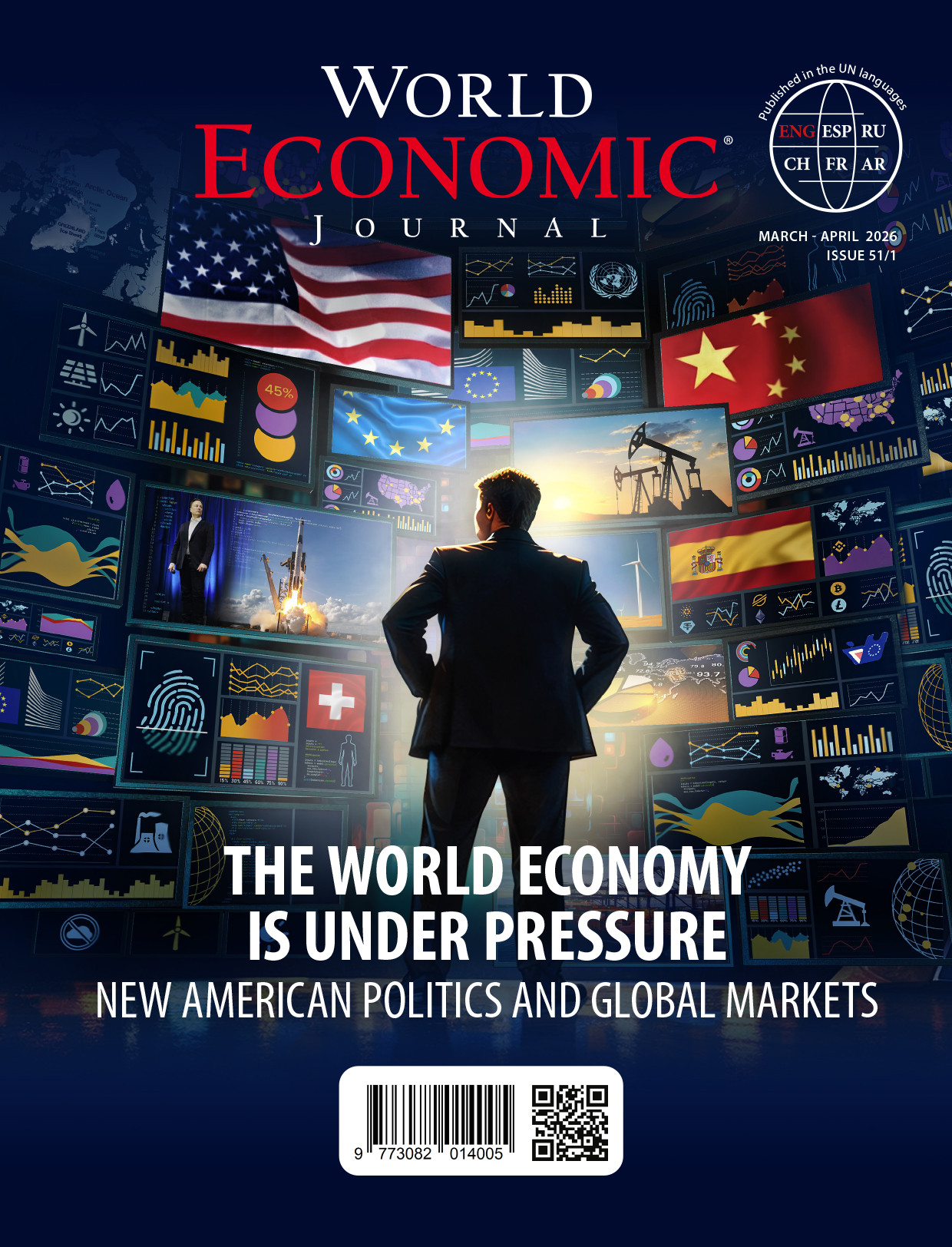
World Economic Journal — March–April 2026 Issue
The New Global Economy Under Pressure
The March–April 2026 issue of World Economic Journal delivers a sharp, data-driven perspective on a global economy entering a new structural phase—defined not by temporary volatility, but by deep systemic transformation.
From escalating trade wars and the reconfiguration of global supply chains to the economic reality of artificial intelligence and the rising importance of strategic investment hubs, this issue provides decision-makers with a clear framework for navigating uncertainty.
This is not just analysis. It is a strategic map of where global capital, risk, and opportunity are moving next.
IN FOCUS
The World Economy is Under Pressure: New American Politics and Global Markets
The issue opens with a critical examination of the renewed wave of U.S. protectionism and its global consequences.
As tariffs expand across key trading partners—including China, the EU, and emerging economies—the global economy is becoming increasingly fragmented. By the end of 2025, a significant share of global trade flows was already affected by new tariff measures, reshaping supply chains and increasing systemic risk .
This analysis demonstrates a key reality:
modern trade wars are no longer bilateral—they are systemic shocks affecting entire economic networks.
For investors and policymakers, the implication is clear: volatility is no longer episodic—it is structural.
FINANCE
Monetary Policy, Markets, and the Search for Stability
In a world of persistent uncertainty, financial markets are sending mixed signals.
On one hand, equities—especially AI-driven tech stocks—continue to rally. On the other, investors are simultaneously allocating capital into traditional safe havens such as gold and real estate, both reaching record highs.
This dual positioning reflects a deeper shift:
markets are no longer choosing between risk and safety—they are pricing both simultaneously.
At the same time, central banks remain cautious. The Federal Reserve signals potential rate cuts, while the ECB adopts a wait-and-see approach amid fragile growth and ongoing geopolitical risks .
INVESTING
Liquidity, Market Structure, and the Breakdown of Old Assumptions
The issue highlights a critical but underappreciated risk: the fragility of market liquidity.
Recent stress episodes have shown that liquidity disappears exactly when investors need it most. Treasury market depth can collapse dramatically, while traditional diversification strategies fail under pressure.
This leads to a fundamental conclusion:
the concept of “safe assets” is being redefined in real time.
For institutional investors, this represents a structural shift in portfolio construction and risk management.
TECHNOLOGY
The Spectre of Solow: The Macro View
The Cost Audit: Capex vs. Opex
One of the most powerful sections of this issue addresses the economic reality of artificial intelligence.
Despite massive global investment, AI is not yet delivering broad productivity gains. Instead, it is introducing new costs, new constraints, and new inequalities.
Among the key insights:
- The end of “zero marginal cost” in software economics
- The rise of compute-driven cost structures
- The need for continuous infrastructure reinvestment by tech giants
- The growing gap between large-scale players and the rest of the economy
Companies are investing billions not to accelerate growth—but to maintain it.
This leads to what the issue defines as a new paradigm:
AI as a tool of resilience, not exponential productivity.
MARKETS
Egypt as a Frontier Market: Infrastructure Ambitions, Growth Limits, and Investment Risks
Egypt represents one of the most compelling—and complex—investment stories in today’s emerging markets landscape.
Massive infrastructure investments have transformed the country’s physical landscape. However, this growth model is increasingly constrained by rising debt, currency volatility, and structural inefficiencies.
The core question explored in this analysis:
Can infrastructure-driven growth translate into sustainable economic performance—or does it increase systemic vulnerability?
ANALYTICS
Turkey as a Regional Hub: Logistics, Investment Regimes, and U.S. Trade Policy Impacts
Turkey is emerging as a ключевой транзитный узел в новой архитектуре глобальной торговли.
Driven by supply chain reconfiguration and increasing demand for nearshoring, the country is attracting significant attention from global logistics and industrial players.
However, its future trajectory depends on external dynamics—including EU relations and escalating U.S. trade tensions.
This makes Turkey a classic example of the new global reality:
high opportunity, but equally high sensitivity to geopolitical shifts.
NEWS
Special Economic Zones as Points of Stability
In a world defined by volatility, special economic zones (SEZs) are becoming islands of predictability.
This issue introduces a new long-term editorial focus on SEZs as strategic instruments of economic resilience. Investors are no longer evaluating entire countries—they are selecting specific territories where rules, infrastructure, and execution are optimized .
SEZs are evolving into:
- industrial and logistics platforms,
- technology and innovation clusters,
- investment gateways in fragmented global markets.
They are no longer a policy tool—they are a core element of the new economic architecture.
CONCLUSION
A Structural Shift, Not a Cycle
The March–April 2026 issue of World Economic Journal makes one thing clear:
The global economy is not slowing down—it is transforming.
- Trade is fragmenting
- Capital is concentrating
- Technology is redefining cost structures
- Markets are repricing risk
We are moving from an era of efficiency to an era of resilience.
For those making strategic decisions—investors, policymakers, and business leaders—this issue provides not just insight, but clarity in a world where clarity is increasingly rare.
