

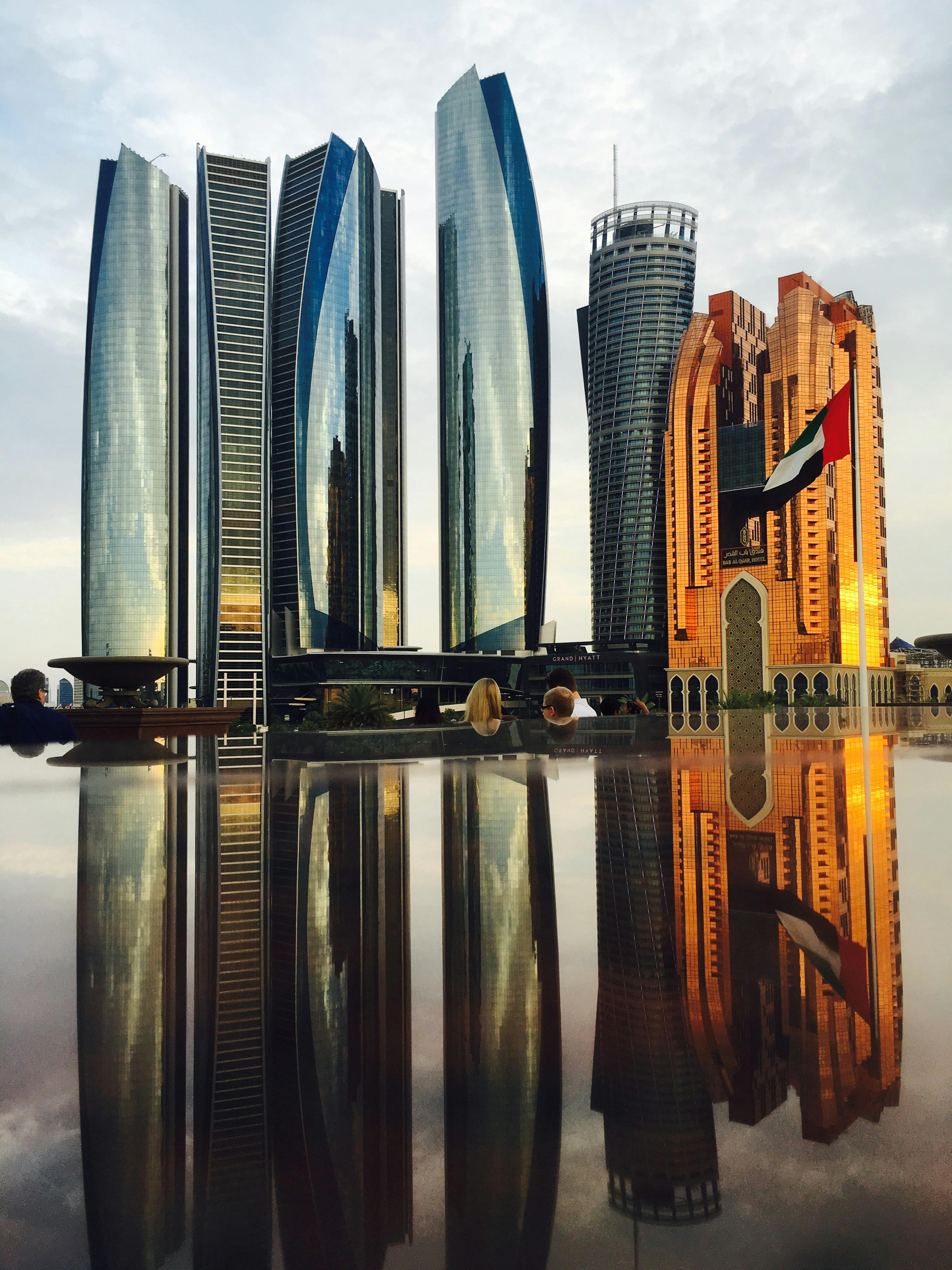
 How the UAE’s port infrastructure, free zones, and strategic neutrality are reshaping global trade flows and capital positioning amid U.S. tariff fragmentation.
The United Arab Emirates (UAE) is one of the few jurisdictions where the structural logic of neutral economic positioning has been directly translated into financial and trade gains amid rising economic trade fragmentation. Trade barriers are increasing, geopolitical blocs are forming and disintegrating, and global supply chains are also organizing. The UAE lies at the intersection of sea routes linking Europe, Asia, Africa, and the Arabian Peninsula, which centuries of trade history have already proven.
That position is not relevant solely due to its geography. It is institutional, regulatory, and infrastructural. Over the past forty years, the UAE has built a multi-layered infrastructure of free zones, port facilities, financial centres, and bilateral trade agreements that together serve as an economic operating system for companies to navigate cross-border complexity.
This article examines the UAE’s hub positioning through the lens of five interconnected analytical domains: the physical logistics infrastructure that underpins cargo throughput; the free zone and investment regime architecture that channels capital flows; the UAE’s deliberate strategic neutrality between competing economic blocs; the direct and indirect impacts of U.S. tariff policy on UAE-routed trade and investment; and the structural risks and regulatory constraints that define the limits of the model.
Logistics Infrastructure: The Physical Architecture of a Global Hub
1. Port Infrastructure
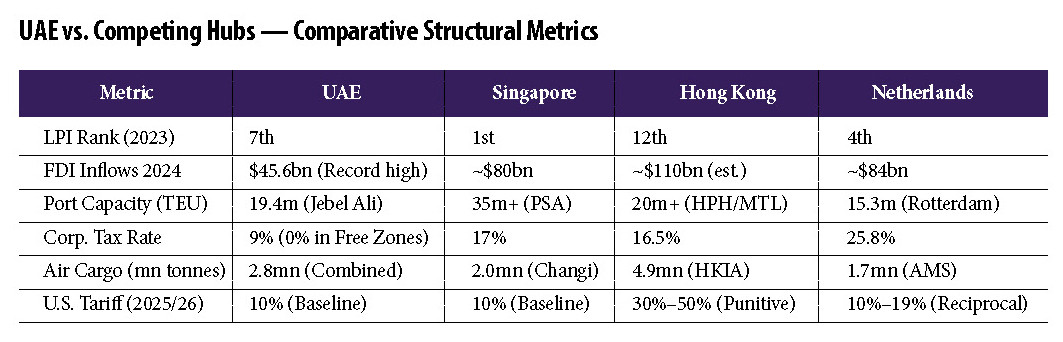
UAE hub positioning is based on the structural support of the infrastructure, the most vital of which is Jebel Ali Port in Dubai. Jebel Ali is the biggest container terminal in the Middle East and Africa, with a yearly container handling capacity of 19.4 million twenty-foot equivalent units (TEUs) across four terminals, more than 100 berths, and a quay length of 25 kilometres that is continuous and managed by DP World. Jebel Ali has recorded its highest TEU container throughput since 2015, with a total of 15.5 million TEUs in 2024, a growth of about 1 million TEUs compared to 2023, representing approximately 18% of the total global TEU of 88.3 million TEUs handled by DP World in 2024.

2. Air Cargo Capacity
Air freight is a dimension of the UAE logistics hub architecture that is structurally distinct but increasingly important. Although air cargo contributes only 1 percent of all trade by volume, these goods are estimated to provide approximately 35% of the total value of all trade globally, a figure that makes air freight an important infrastructure for high-value, time-sensitive inventory (such as pharmaceuticals, electronics, luxury goods, and express shipments via e-commerce).
According to Airports Council International (ACI), Dubai International Airport (DXB), the biggest airport globally in terms of international passenger traffic, recorded 2.2 million tons of air cargo in 2024, a 20.5 percent increase over 2023. In terms of ACI cargo airport rankings, this event pushed DXB up from 17th to 11th in the globe, which was the largest increase of any of the top 20 airports that year.
Together, DXB and Dubai World Central (Al Maktoum International Airport) handled 2.8 million tonnes of traffic in 2024, representing an 18.5% yearly increase. DXB offers directional coverage of what a true transshipment center needs, with 272 destinations to 107 countries via 106 international airlines.
Over the next ten years, the proposed 35 billion investment program for the expansion of Al Maktoum International Airport is expected to raise total cargo capacity to 12 million tonnes annually, placing the UAE’s air freight infrastructure among the top three cargo hub systems globally.

3. World Bank Logistics Performance Index
Infrastructure quality in the United Arab Emirates is confirmed by sovereign logistics performance ratings. The UAE is rated at 4.0 out of 5.0 in the World Bank’s 2023 Logistics Performance Index (LPI), which ranks 12 leading economies, including Singapore, Finland, Denmark, the Netherlands, Switzerland, Germany, and others. This is an improvement of 4 spots from the UAE’s 11th-place ranking in 2018.
In the most recent LPI cycle, the UAE topped both the Arab world and the GCC. Every one of the six LPI assessment dimensions—customs efficiency, infrastructure quality, ease of organizing international shipments, UAE logistics hub service quality, tracking and tracing, and timeliness—received competitive scores. During the May–October 2022 reference period, the average number of days spent in UAE ports was four, which is a favorable comparison to the seven days spent in the U.S. and the 10 days spent in Germany.
Free Zone Architecture and Investment Regime Design
1. Free Zone Model Structure and Incentive Logic
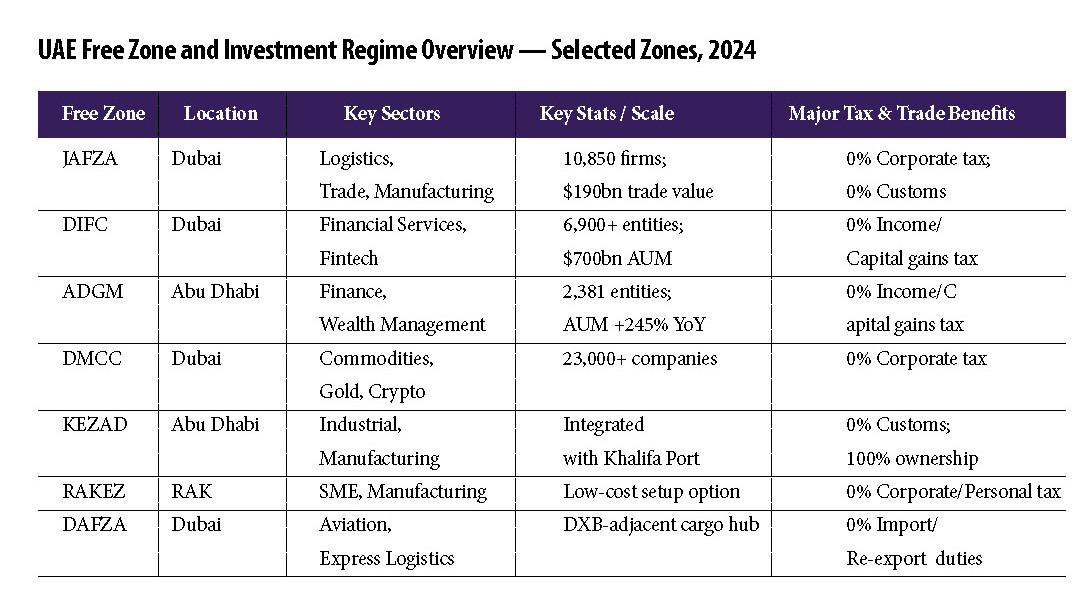
In its seven emirates, the United Arab Emirates has established more than forty-five free zones that are legal entities with their own licensing and regulatory systems. This architecture is the primary means of attracting, retaining, and enabling foreign capital, and it has no effect on the competitiveness of the UAE. 100% foreign ownership, no personal income tax, no company tax on qualifying income, no customs duty on items to be traded in the zone or reexported, and no restrictions on capital and profit repatriation are all benefits enjoyed by free zone firms.
There are functional divisions in the free zone paradigm. Free zones for manufacturing and logistics draw businesses engaged in physical trade, production, and distribution, the major of which are the Jebel Ali Free Zone (JAFZA) near Jebel Ali Port, Khalifa Industrial Zone Abu Dhabi (KIZAD), and Ras Al Khaimah Economic Zone.
Focused on financial services, fund management, and investment structuring, the Dubai International Financial Centre (DIFC) and the Abu Dhabi Global Market (ADGM) are financial free zones with their own independent courts and authorities. Commodity-specific free zones, like the Dubai Multi Commodities Centre (DMCC), are controlled trade areas for commodities like gold, diamonds, energy, and agriculture.

2. JAFZA: Trade Volume and Corporate Ecosystem
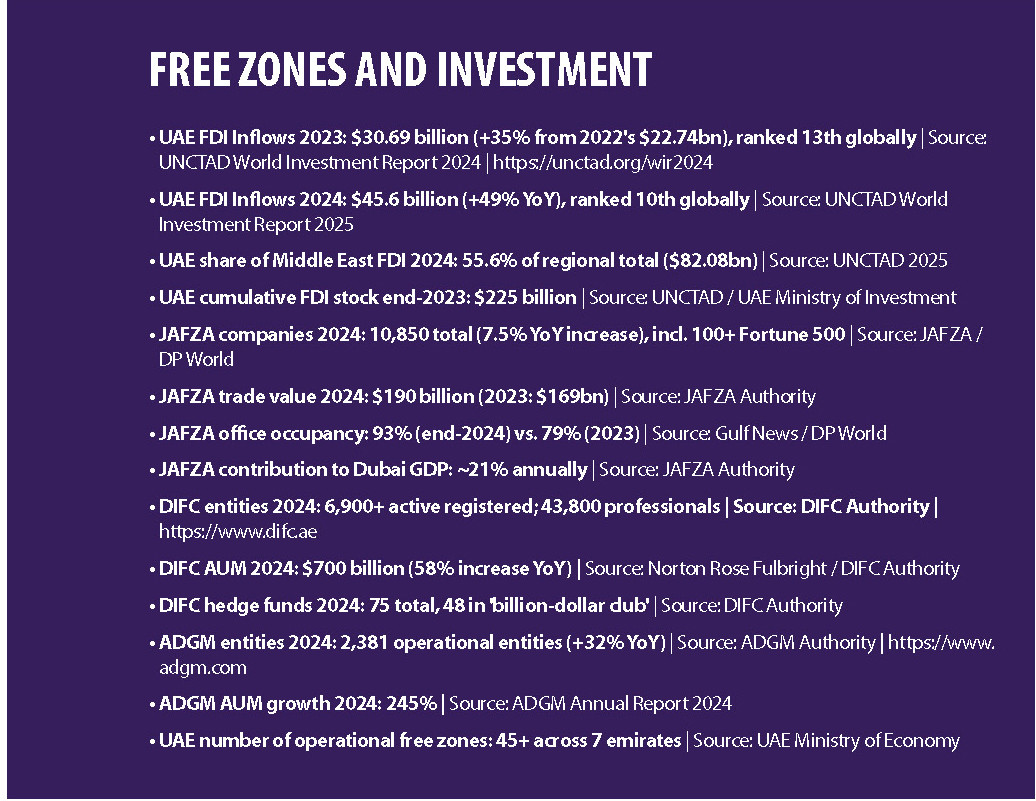
The main focus for trade-related business activity in the United Arab Emirates is JAFZA, which was established in 1985 as the country’s first free zone and is managed by DP World. As of 2024, there were 10,850 registered businesses in JAFZA, including over 100 Fortune Global 500 companies. Office occupancy rates increased to 93%, a 7.5% increase over 2023.
The trade value of companies based in JAFZA increased from $169 billion in 2023 to $190 billion in 2024. The zone contributes 21% of Dubai’s yearly GDP and roughly 23.9% of all foreign direct investment in the city. It keeps about 144,000 workers in direct employment. In October 2024, fDi Intelligence named JAFZA as the number one winner in its Global Free Zones of the Year category, becoming the first free zone in the Middle East to receive this honour.
3. Financial Architecture, DIFC and ADGM
The DIFC and the ADGM are the main international interfaces of the UAE in the case of financial capital structuring. By the beginning of 2024, there were more than 410 wealth and asset management companies in the DIFC, 75 of which were hedge funds (48 of them in the billion-dollar club), and total assets under management soared by 58 to reach 700 billion.
In 2024, DIFC indicated a 25% growth of licensed firms with a total of more than 6,900 active registered firms, including 43,800 professionals in the financial sector. The growth of ADGM in 2024 was more pronounced: a 245% growth, which was due to the migration and setup of sovereign wealth fund subsidiaries, family offices, and UAE global economy asset managers attracted by the zone due to its proximity to the government capital of Abu Dhabi.
The legal frameworks of both centres, and their English-language courts, internationally recognisable standards of contract, and separate regulators (the Dubai Financial Services Authority and the Financial Services Regulatory Authority, respectively) furnish the legal infrastructure sophisticated institutional investors need when engaging in cross-border capital activities. The extensive network of more than 193 Double Taxation Avoidance Agreements (DTAAs) and Bilateral Investment Treaties further minimizes withholding tax friction and risk of capital repatriation, making the UAE a viable location to operate its fund structures globally.
FDI Flows and Capital Positioning
1. FDI Performance Trajectory
FDI data released by UNCTAD affirms the established status of the UAE as a global capital magnet. The 2023 inflows of UAE FDI were 30.69 billion (compared to 22.74 billion in 2022), making the country the 13th in the world by total inflows, according to the UNCTAD World Investment Report of 2024. The next UNCTAD World Investment Report 2025 documented another jump: UAE FDI inflows 2024 were 45.6 billion, and the year-on-year growth was 49%, propelling the country to the 10th position in the world. The UAE received 55.6 percent of all FDI inflows into the Middle East in 2024, amounting to $82.08 billion. The concentration indicates the level of structural differentiation between the UAE and other economies of the Gulf regarding the transparency of regulations, the level of infrastructure development, and the sophistication of the legal system.
The announcements of Greenfield FDI projects show an equally educative image. In 2023, the UAE ranked second worldwide in the number of announced greenfield FDI projects; only the United States had more, with 1,323 announced, a 33% increase from 2022. This indicator, which measures new capital commitments, not the financial flows by existing structures, indicates the true productive investment, not financial transiting.
The cumulative FDI stock at end-2023 stood at approximately $225 billion. The UAE’s National Investment Strategy 2031, approved by the Federal Cabinet in March 2025, targets more than doubling annual FDI inflows from the 2023 baseline to $65.3 billion by 2031, with a cumulative FDI target of AED 1.3 trillion, and an ambition to triple the cumulative FDI balance to AED 2.2 trillion. The strategy emphasises five priority sectors: advanced manufacturing, logistics, financial services, renewable energy, and information technology.
2. Non-Oil Trade Performance
In 2024, UAE non-oil foreign trade reached a record AED 2.997 trillion, 14.6 percent higher than in 2023, when global trade was rising by about 2.4 percent, a divergence of about six times. In 2024, total foreign trade in the UAE (including hydrocarbons) is AED 5.23 trillion (1.42 trillion), a 49% improvement over 2021 figures.
Re-exports as a structural indicator of the position of the hub also reached AED 734 billion in 2024 and are increasing at a rate of 7.3 per annum. The value of export of non-oils to CEPA partner countries was AED 135 billion, which is a 42.3 percent growth compared to 2023. In 2024, the UAE was ranked 11th in the world in terms of merchandise exports, with 2.5% of merchandise exports in the world.

Strategic Neutrality and Positioning in a Bloc
1. Structural Neutrality as Policy Structure
UAE strategic neutrality should not be confused with political non-alignment or apathy. Instead, it is a deliberately maintained structural stance: the UAE maintains substantive economic ties with the United States, China, India, Europe, and a variety of new market economies, without committing itself to either bloc. This pose is legalised in a network of trade and investment agreements, diplomatic engagement practices, and regulatory provisions such that each economic relationship is technically autonomous of the others.
Such an architecture can be exemplified by the Comprehensive Economic Partnership Agreement (CEPA) programme introduced in the UAE in 2021. As of February 2026, the UAE had finalized 28 CEPAs, of which 10 were fully operational, including India, Indonesia, Israel, Turkey, Cambodia, Georgia, Costa Rica, Mauritius, Serbia, and Jordan. It has agreements with Australia, South Korea, Malaysia, Vietnam, Colombia, Chile, Kenya, Ukraine, New Zealand, Belarus, Azerbaijan, and the Philippines in different stages of implementation or finalisation. The CEPA network covers a wide range of countries that represent different geopolitical orientations at the same time, which is a structural diversification that enables UAE trade flows to react dynamically to changed world conditions.
“Global companies may pivot their focus away from the U.S. and toward countries like the UAE to benefit from their strategic locations, robust infrastructure, and access to alternative markets. This is likely particularly true in relation to Chinese goods.”
— Dr. Totis Kotsonis, Trade Law Expert, Pinsent Masons (December 2025)

V. U.S. Tariff Policy: Architectural Effects on the UAE Trade and Capital Flows
1.The Tariff Architecture and the Positioning of the UAE
The reciprocal tariff regime announced by the Trump administration on April 2, 2025, consisting of a baseline of 10% customs duty on goods imported into the United States by all countries, with higher tariff rates gradually rising over time by the amounts of significant trade deficits, supports the hub model of the UAE. The UAE was even charged with the standard rate of 10 percentage point, as opposed to higher rates charged to such countries as China (estimated rates ranging between 34-55% point including base and 301 and other levies), India (26 percentage point at the time of its announcement, though later to be negotiated), Vietnam (46 percentage point) and other Asian manufacturing economies.
The tariff differential between the 10% rate in the UAE and the rates applied to competing Asian manufacturing centres provides a business case for companies to assess whether UAE-based production or assembly can replace higher-tariffed sources in the U.S. market. The tariff saving that results in the effective tariff may be between 16 and 45% points, and this is based on the country of origin that is being displaced. This business reasoning has been translated into some visible growth in the number of corporate inquiries to UAE free zone officials on the subject of manufacturing and assembly licensing, as mentioned by a number of various zones by mid-2025.
2.Trade Rerouting Dynamics
There is no automatic generation of legitimate trade rerouting by tariff differentials. The U.S. Customs and Border Protection has origin rules that goods must have undergone substantial transformation, that is, have undergone material change in tariff classification, have undergone material value addition, or have gone through a defined manufacturing process to be considered originating in a third country. Basic transshipment, repacking, or relabelling is not exempt, and it is liable to penalty, and 40% extra duty is imposed on suspected transshipment. This regulatory restriction is structurally significant: this constrains the extent to which UAE free zones can act as pass-throughs to conduct tariff arbitrage, and direct commercial incentives to the reality of value-addition investment.
According to Osama Al Saifi, Managing Director of MENA at Traze.com, exporters in the United Arab Emirates cannot legally avoid new U.S. duties by simply routing traffic through a free zone in the United Arab Emirates. This would require re-engineering of supply chains in such a way that goods satisfy country-of-origin requirements in the U.S., as UAE goods are manufactured. That needs to move activities of cutting, polishing, and casting or assembly to Emirati plants. Even qualifying production would still have to contend with the 10 percent floor tariff in the U.S. This institutional fact implies that the main beneficiary of the reconfiguration of supply chains entailed by tariffs is not the UAE as a transshipment hub, but rather the UAE as a true manufacturing and processing place—a difference with significant implications about the industrial investment, employment, the degree to which the UAE is functionally integrated into global value chains.
3. Capital Flow Displacement and Effects of Financial Hubs
The UAE’s positioning under U.S. tariff policy is not limited to logistics routing but also includes the redirection of capital flows. Fragile global supply chains and unpredictability ascribed by changing trade policy have provided incentives to multinational corporations and institutional investors to create or increase regional holding companies in jurisdictions that are free of law and tax regimes that are tax-free and are not directly in the line of bilateral U.S.-China confrontations. The UAE and its financial structures of DIFC and ADGM have been direct beneficiaries of this trend.
The high-net-worth individual migration rate of inbound HNWIs, with an estimated rate of about 4,500 ultra-high-net-worth people per year in recent years, has also resulted in family offices and wealth management units being established within DIFC and ADGM. Asian (especially Singapore, Hong Kong, and growing mainland China) and European family offices, Indian and U.S. family offices, have set up a presence in Dubai or Abu Dhabi to manage Middle Eastern and African market exposure, and to hold investment portfolios under the protection of DTAA.
The institutional credibility of UAE financial structures to international capital was enhanced materially by the fact that the FATF took the UAE off its financial monitoring greylist in February 2024, after two years of regulatory reform to enhance both its anti-money laundering regime and counter-terrorist financing framework.
Trends of Corporate Structuring and Headquarters Relocation
1. Regional Headquarters and Global Holding Structures
One structural implication of the economic trade fragmentation in the world has been a systematic re-evaluation of multinational corporations over the optimal jurisdiction of the regional headquarters, the holding company structures, and the treasury operations. The UAE and Dubai, in particular, have become the destination of choice to a large group of firms, most notably those that have high levels of exposure to Asia-Africa-Middle East business and which would like to take out functional or structural operations out of jurisdictions that are directly and actively exposed to open geopolitical risk or regulatory ambiguity. A legal framework that institutional investors and corporate treasury functions need is the DIFC, which has an English common law system and an independent court system. ADGM provides comparable infrastructure in Abu Dhabi, with the added benefit of proximity to sovereign wealth capital.
This trend goes up to commodity and trading firms. DMCC has become one of the biggest commodity trading facilities in the world, with a population of more than 23,000 registered companies dealing in gold and diamonds, energy products, and agricultural products. The infrastructure of physical commodity handling (gold-vaulting and diamond trading facilities of Dubai), regulatory framework, and network of DTAA enable the DMCC to be structurally competitive with Geneva, London, or Singapore in some commodity trade structure.
2. Structuring of the Company in China through the UAE
One pattern in particular, in which the UAE free zone entities (primarily JAFZA, DMCC and Dubai South) are used as a corporate vehicle to manage non-China exposure of supply chains, access markets on which the company is subject to Chinese sanction or trade restrictions and to hold foreign intellectual property or financial assets beyond the reach of Chinese capital controls, has been documented. This trend has escalated since 2023, when the U.S. investment screening has expanded to include a wider range of technologies, complicating direct Chinese involvement in some international business operations. The structural non-alignment of the UAE in U.S.-China tensions offers a legally viable intermediation point of valid cross-border structuring of corporate organizations—but this intermediary also has the due diligence and compliance risks discussed in Section VII.
3. Structuring of Market Access using CEPA
The CEPA programme establishes a unique corporate structuring incentive: companies may rely on a UAE free zone entity as the contractor in the agreement with the CEPA partner states and receive the advantage of preferential tariff rates and the market access opportunities which are offered to UAE-origin goods and services. Having ten active CEPAs serving an estimated 2.5 billion in the trade network, with more discussions with other key economies, the UAE CEPA ecosystem is transforming into a true trade facilitation infrastructure. There was an improvement of 42.3% growth in non-oil exports to CEPA partner countries in 2024 to AED 135 billion, showing that the commercial utilisation of CEPA is quantifiable and gaining a faster pace.

Risks related to Structure and Constrained Regulations
1. U.S. Sanctions Compliance and Secondary Tariff Exposure
The UAE’s structural benefits in its role as a neutral mediating power between rival economic blocs are predetermined by its vulnerability to U.S. sanctions. The UAE has strong trade connections with Iran, its second-largest trading partner, and much of the business undertaken in the UAE is re-exports to, or passing through, the Iranian market or companies with Iranian beneficial ownership. The U.S. policy of secondary sanctions has been focused on non-U.S. individuals who conduct business with sanctioned individuals, and the UAE-based trading companies and financial institutions were the target of the U.S. enforcement measures and regulatory screening.
The U.S. declared a 25% tariff on nations that have substantial commerce with Iran in January 2026. This act directly involves the UAE exporters and the financial institutions, considering the magnitude of the UAE-Iran business relations. Analysts estimated that this additional tariff exposure, on top of the current 10% duty, would reduce potential growth by 0.3 to 0.5 points in trade volume bound for the U.S. if trade volumes shrink significantly. The compliance framework that would allow differentiation between legal UAE-based activity and Iran-related exposure would pose operational complexity and costs for UAE-based companies seeking to enter the U.S. market.
2. Transshipment and Rules of Origin Enforcement
According to the aforementioned, U.S. Customs enforcement has been subjecting goods that transit through third-country hubs to tougher inspections of origin claims. The fact that the UAE is a large re-export hub introduces natural vulnerability to allegations of origin washing, especially when the products manufactured in the Chinese or Indian high-tariff market are transferred through UAE free zones and re-exported with UAE origin documentation that does not indicate any substantial transformation.
Although the regulatory system clearly forbids such practice and the UAE federal customs is undertaking more checks on compliance, the amount and variety of goods passing through the UAE system present a practical difficulty in enforcement. Firms that do not invest heavily in documenting the origin of their supplies and managing compliance risks face reputational and legal risks in the United States and the UAE.
3. Corporate Tax Transition
The adoption of a federal corporate income tax of 9% on business profits greater than AED 375,000, the first in UAE history, which will be effective in fiscal years beginning June 2023, and the subsequent introduction of a Domestic Minimum Top-Up Tax (DMTT) of 15 percent, which will be effective in January 2025 (the UAE will follow the OECD/G20 Pillar Two global minimum tax framework of multinational enterprises), will be structural changes to the UAE fiscal landscape. Although the new regime does not change the fact that the free zone entities can continue to enjoy a 0% tax on qualifying income generated out of the activities not carried out in the UAE, the new regime lowers the absolute level of the UAE tax benefit relative to the legacy comparisons and creates additional compliance demands on multinational organizations. The DMTT effectively reduces the difference between the jurisdiction and other competitive jurisdictions in the context of globally mobile corporate structures that were mostly relying on UAE entities to minimise taxes.
The Final Note
This is not a new phenomenon; the UAE is an institutional product of four decades of systematic infrastructure building, construction of regulatory architecture, and strategic placement as a neutral logistics, financial, and investment hub in a fractured global economy. What the existing wave of U.S. trade policy activism has accomplished is to make that positioning more commercially salient—through the creation of tariff differentials that render UAE-based manufacture and processing economically competitive and through establishing dislocations of capital flow forms that shift the management and holding structures to the jurisdictions characterized by legal stability and geopolitical impartiality.
The 2024 figures of the UAE, 15.5 million TEUs at Jebel Ali, 45.6 billion FDI inflows, AED 2.997 trillion non-oil foreign trade, and 2.8 million tonnes of combined air cargo and 700 billion in the DIFC assets under management, all of which record a hub with a structure running at or close to full capacity. The problem with the positioning of the UAE in the medium run is not its logistics or capital appeal, but rather regulation depth. This will require continued hub status in an increasingly scrutinised world of global trade and financial activity.
By Jonesha Smith
Photo: Mohamed almari / pexels.Com, Mohamed almari / pexels.Com, DP World, Courtesy of UAE Government Media Office
____________________________________________________
World Economic Journal continues to examine how strategic hubs such as the UAE are reshaping capital flows, trade corridors and cross-regional investment dynamics in an increasingly fragmented global economy.
As global alignments evolve, neutral platforms with regulatory stability and financial sophistication are becoming critical nodes in the new economic architecture.
For leaders, investors and policymakers seeking structured, cross-regional insight – World Economic Journal provides independent, analytical perspectives that go beyond headlines.
To explore partnership opportunities, expert contributions, interviews or strategic visibility initiatives, contact us at: editorial@world-economic.com
Follow World Economic Journal for continuous insight on global markets, capital mobility and economic transformation.
Insights. Innovation. Impact.
